History / Nevada context
Nevada's Gold Rush: Placer Camps of the Silver State
How gold fits into a state built on silver, and why placer camps like Osceola were the exception.
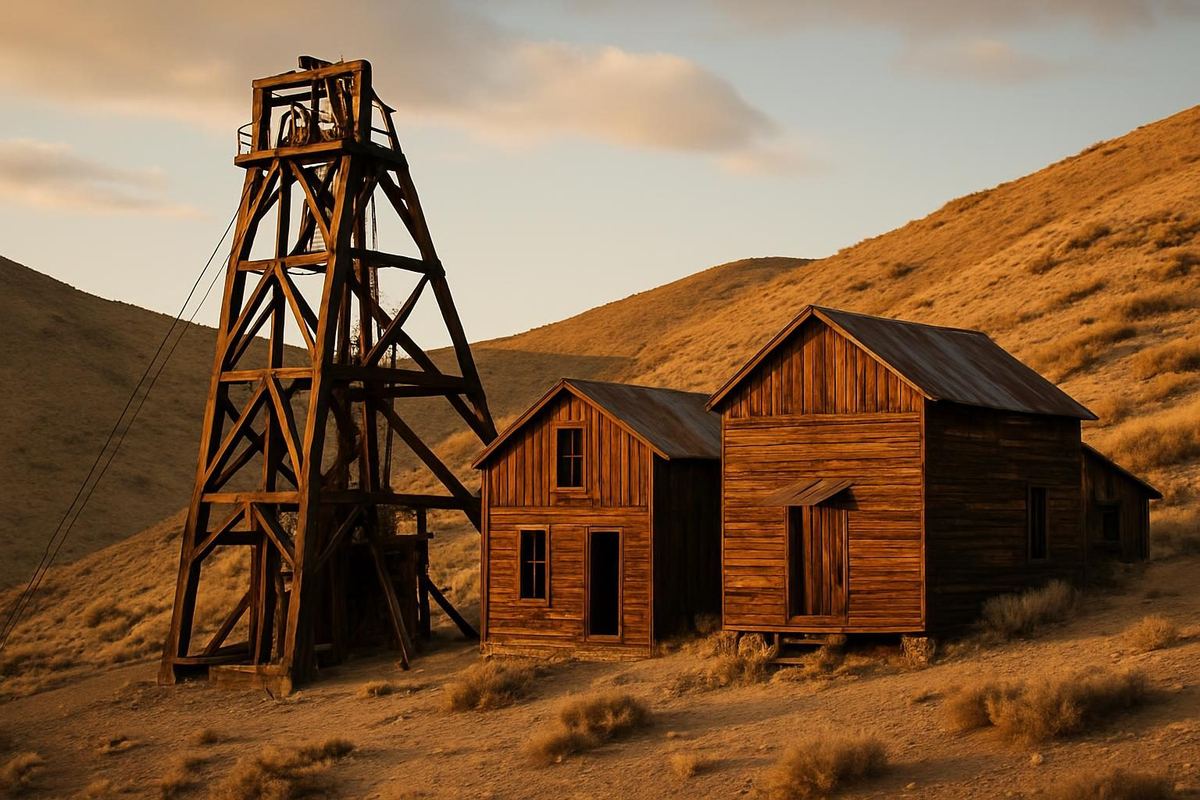
When people picture a gold rush they think of California in 1849. Nevada's gold story is quieter and stranger, scattered across a vast basin-and-range desert, tangled up with silver, and stretched over more than a century. Understanding it puts Osceola in context.
Silver first, gold throughout
Nevada's mineral history opens with the Comstock Lode in 1859 and the silver camps that followed: Austin on the Reese River in 1862, Eureka in the 1860s, then the twentieth-century booms at Tonopah and Goldfield. Gold ran through all of it, sometimes as a byproduct of silver, sometimes as the main prize. But most of this was lode mining, hard rock blasted from veins and bodies underground.
The placer exception
Placer gold, the free metal in stream gravels and alluvial fans, is comparatively rare in Nevada, which is what made the placer districts notable. Osceola in White Pine County was the most famous, the richest and longest-lived of them. Others included Spring Valley in Pershing County, the Round Mountain and Manhattan placers in Nye County, and the Rye Patch and Majuba Mountain ground in Pershing County, which became one of the best nugget-detecting areas in the country. Each worked the same principle: water had already done the hard job of freeing and concentrating the gold, and miners simply had to recover it.
Modern Nevada gold
Today Nevada is one of the largest gold producers in the world, but almost none of it looks like a gold rush. The state's output comes mostly from Carlin-type deposits, discovered along the Carlin Trend from the 1960s, where the gold is so finely disseminated in rock that it is invisible to the eye and recovered by large-scale processing. That modern industry is a world away from a prospector swirling a pan, which is part of why the old placer camps still hold their romance. The methods that built them are also still legal to practice, within limits, on Nevada's public land, and we cover them in our prospecting guides.