History / Osceola district
The Osceola Mining District: Nevada's Great Placer Camp
Nevada's richest and longest-lived placer camp, and the source of the largest gold nugget ever found in a Nevada placer.
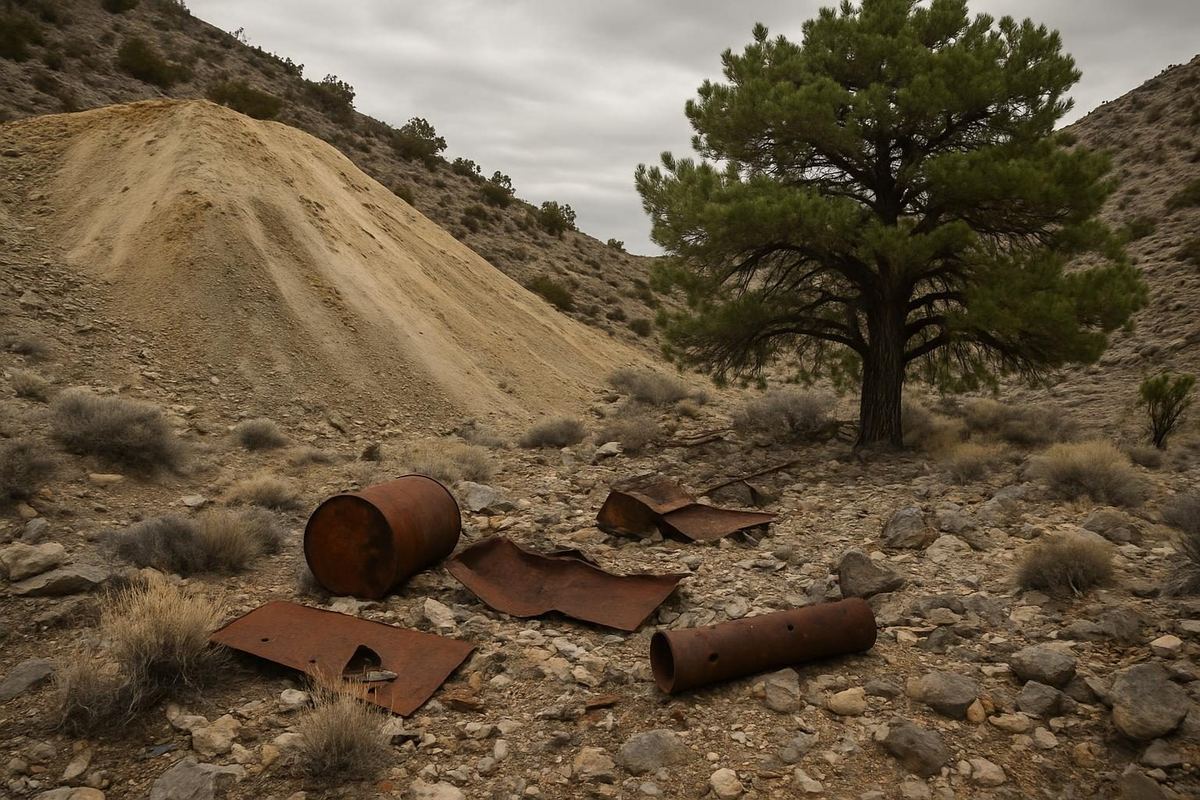
The Osceola mining district sits on the west flank of the Snake Range in White Pine County, Nevada, a few miles west of what is now Great Basin National Park. It is quiet country today, but for a stretch of the late nineteenth century it was the scene of the most ambitious placer gold operation the state had seen, and the source of the largest gold nugget ever recorded from a Nevada placer.
The District Ledger — Osceola, White Pine County
| District organized | Oct 1872 |
| Placer gold discovered (John Versan) | 1877 |
| Documented production, gold | ~133,665 oz |
| Documented production value (USGS) | ~$1.9M |
| Largest Nevada placer nugget, Dry Gulch | ~24 lb |
| East Osceola Ditch, length | 18 miles |
| East Osceola Ditch, cost | $108,222.65 |
| East Ditch completed | Jul 4 1890 |
| Peak town population (1882) | ~1,500 |
Two discoveries: lode first, then the bonanza
Prospectors organized the district in October 1872 after finding gold in quartz veins about three miles west of the present park boundary. That lode gold looked promising on paper, but it was locked in hard Cambrian quartzite and never paid well on its own. The real event came in 1877, when a prospector named John Versan found placer gold in the gravels between the gulches. Placer gold is free metal, already weathered out of its rock and concentrated by water, and it can be recovered with simple tools. Word spread, several hundred prospectors rushed in, and by 1882 the town of Osceola held around 1,500 people, with stores, saloons, stage lines, and in time electricity and a telephone.
Hydraulic mining and the water problem
The placer gravels at Osceola were deep, dry, and spread across alluvial fans covering more than a thousand acres. Pans and rockers could not touch that volume, so from the early 1880s the operators turned to hydraulic mining: aiming high-pressure water cannons at the hillsides to wash whole slopes of gravel through sluices lined with mercury. It was the same technology that had torn up the California gold country, and it needed one thing above all, water, which the arid Snake Range could not easily supply where the gold was.
That single problem shaped the district's history. To feed the monitors, the Osceola Gravel Mining Company built two long mountain ditches, the 16-mile West Osceola Ditch in 1884 to 1885 and the 18-mile East Osceola Ditch completed on the Fourth of July, 1890. Even together they never delivered enough steady water, and the mines often ran only a few hours a day. The story of the Osceola Ditch is really the story of the district.
The famous nugget, and what Osceola produced
Osceola's signature find was a single mass of gold pulled from Dry Gulch in the late 1870s, a nugget the U.S. Geological Survey describes as the largest ever recovered from a Nevada placer operation. Accounts put it near 24 pounds; the USGS records it at 25 pounds and dates it to 1877. Period mining journals logged other large finds through the 1890s, including a 125-ounce nugget in 1892. We have not found a documented period dollar value for the great Dry Gulch nugget, and we do not invent one.
Total production is documented by the USGS at roughly 133,665 ounces of gold and about $1.9 million, predominantly placer. The National Park Service cites a larger cumulative estimate near $3.5 million once later reworking is included, and a state historical marker rounds it toward $5 million with minor silver. We lead with the documented USGS figure and note the others rather than pick the biggest number. Osceola was, in the careful phrasing of historians, Nevada's richest and longest-lived placer camp, which is a stronger and truer claim than "most productive."
Decline
The end came the way it began, through water. A fire damaged Main Street in 1890, dry winters through the 1890s cut the snowmelt the ditches depended on, wooden flumes shrank and leaked, and water-rights lawsuits followed. The Osceola Placer Mining Company folded in 1900, and the district was at a standstill by 1905. Later operators reworked the tailings in the 1920s and again after the Second World War, but the camp never returned. A later fire leveled the last of the town, and Osceola became the ghost town it is today.
Frequently asked questions
Where is the Osceola mining district?
What is Osceola known for?
How much gold did the district produce?
Can you visit Osceola today?
Sources & references
- USGS Mineral Resources Data System, Osceola (MRDS #10310456)
- National Park Service, "The Osceola Ditch," Great Basin National Park
- Western Mining History, Osceola, Nevada
- Nevada State Historic Preservation Office, Marker No. 98, Osceola
- National Register of Historic Places, Osceola Ditch registration (#96000584)