Prospecting / How-to
How to Pan for Gold: A Beginner’s Step-by-Step Guide
The oldest way to find gold still works. Here is the gear, the spot, and the motion.
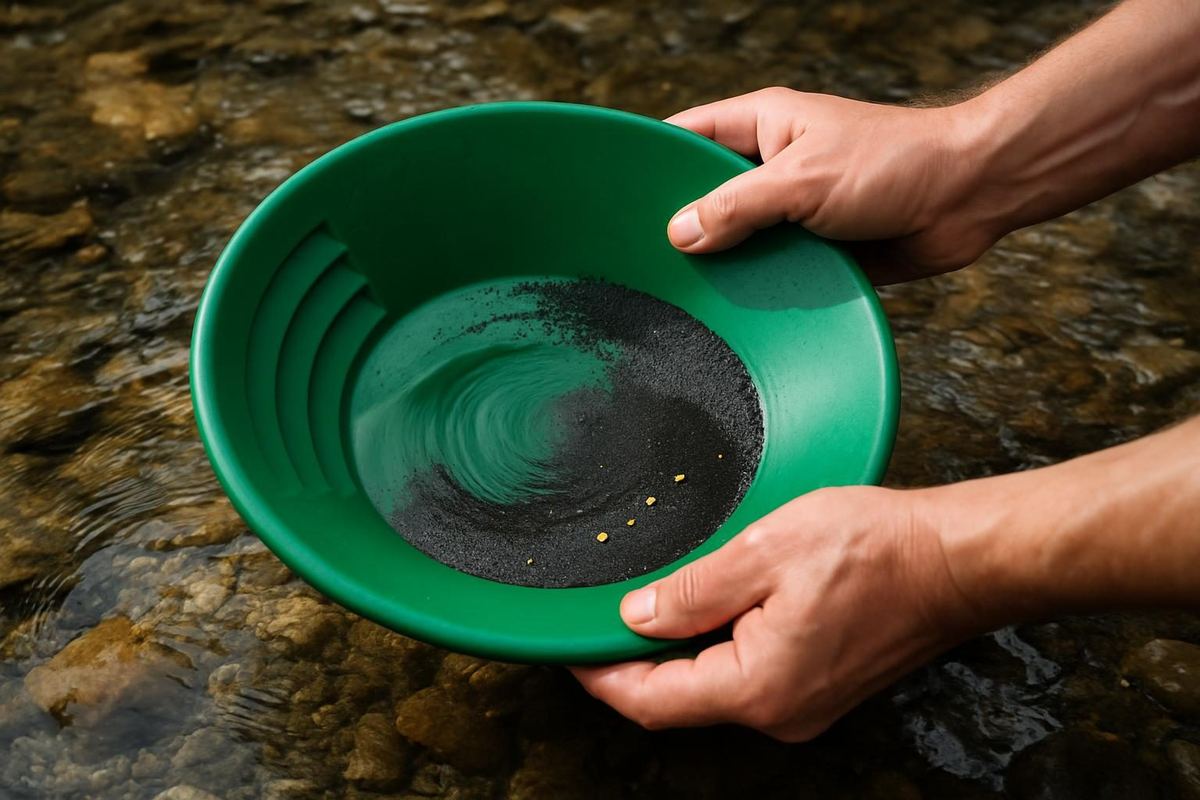
Gold panning is the oldest and simplest way to recover placer gold, and it still works. The whole method rests on one fact: gold is about nineteen times denser than water and far heavier than the sand and gravel around it. Give that gold a chance to sink while you wash the lighter material away, and it will collect at the bottom of your pan every time. Here is how to do it.
What you need
You can start with almost nothing. A single gold pan, ideally a plastic one with molded riffles on one side, is enough to learn. Add a classifier (a sieve that screens out large rocks), a plastic scoop, a snuffer bottle for picking up fine gold, and a small glass vial to hold what you find, and you have a complete beginner kit for very little money. Skip the powered gear until you know you enjoy it.
Finding a spot
Gold travels downhill with water and drops out of the current wherever the water slows. Look on the inside bends of creeks, behind boulders and other obstructions, in cracks and crevices in bedrock, and at the base of waterfalls or riffles, anywhere the flow loses energy. In placer country like Osceola's, the gold has often been sitting in the same gravels for a very long time. Before you dig, make sure you are allowed to: on Nevada public land, casual hand panning is generally fine, but active claims and protected sites are not, which we cover in prospecting in Nevada.
The technique, step by step
- Fill the pan. Scoop gravel and sand into your pan, about two-thirds full. Screen out the big rocks first with a classifier so you are working only the finer material where fine gold hides.
- Submerge and break it up. Lower the pan into the water and knead the contents with your hands, breaking up clay and mud so any trapped gold can sink.
- Settle the gold. Hold the pan level and shake it side to side underwater. This stratifies the material, heavy gold works down, light sand rises. Give it several firm shakes.
- Wash off the top. Tilt the pan slightly away from you and use a gentle forward-and-back swirl, letting the top layer of light material wash over the lip. Re-level and re-shake often so you never wash away gold that has not yet settled.
- Work down to the concentrates. Repeat until only a small amount of heavy dark sand, the concentrate, remains. This is often black sand, rich in iron, and it is where your gold will be.
- Read the gold. Add a little clean water and swirl slowly. Gold will show as bright, buttery flakes that do not move like the sand. Pick them up with a wet fingertip or a snuffer bottle into your vial.
Common beginner mistakes
The two biggest are working too fast and tilting too steeply, both of which flush fine gold over the edge. Slow down, keep the pan closer to level, and re-settle often. Do all of this with the pan underwater or over a tub, not over open ground, so anything that escapes lands where you can re-pan it. Fine gold is easy to lose and easy to save once you respect how it behaves.